The answer first
If you are starting from a fully ordered deck and want to reach a reasonably random state with the least effort, do a Center Load Shuffle 7 times. For a standard 52-card deck that gets you to 86% of theoretical randomness. For a Skibbo deck (60 cards, values 1–12 repeated five times each) it lands at 79%.
There is a more effective method — Center Load + Strip Combo — but it requires two physical moves per round instead of one. At 7 rounds it reaches 93% (Standard) and 86% (Skibbo), which is better, but the extra effort is roughly double. For a family card game that trade-off rarely makes sense.
What I measured and how
Randomness here is measured by counting rising sequences: runs of cards that are still in their original ascending order. A fully ordered deck has exactly one rising sequence. A perfectly shuffled deck of n unique cards is expected to have (n+1)/2 rising sequences on average — 26.5 for a standard deck, 30.5 for Skibbo. Every simulation measures how close a method gets to that target after a given number of shuffles, expressed as a percentage.
Each method ran 10,000 trials per shuffle count (1–10), on both deck types. The shuffles themselves are imperfect by design: splits land near the middle with a few cards of wobble, and riffle interleaving alternates between 10 and 20 times per pass.
The core rising-sequence counter is the same across all scripts:
def count_rising_sequences(deck):
    count = 1
    for i in range(1, len(deck)):
        if deck[i] < deck[i - 1]:
            count += 1
    return count
The nine methods
- Standard Riffle — split near the middle, interleave the two halves.
- Strip Shuffle — peel packets off the top one at a time, each dropped onto a new pile. Packet order reverses; order within each packet is unchanged.
- Strip + Riffle Combo — one riffle followed immediately by one strip shuffle per round.
- Center Load Shuffle — pull the middle ~third out and place it on top, then riffle.
- Center Load + Strip Combo — center load shuffle followed by a strip shuffle per round.
- Heart Cut Shuffle — pull the middle ~half out, riffle it against the joined top+bottom remainder.
- Undercut Shuffle — cut roughly the bottom third to the top, then riffle.
- Carousel Shuffle — round 1: pull middle third aside, riffle the remaining two-thirds; subsequent rounds: split the shuffled pile in half, set one half aside (replacing the previous aside), riffle the other half with the old aside pile.
- Tilt Shuffle — split the deck unevenly (~2/3 vs 1/3), then riffle.
Results — Standard deck (52 cards)
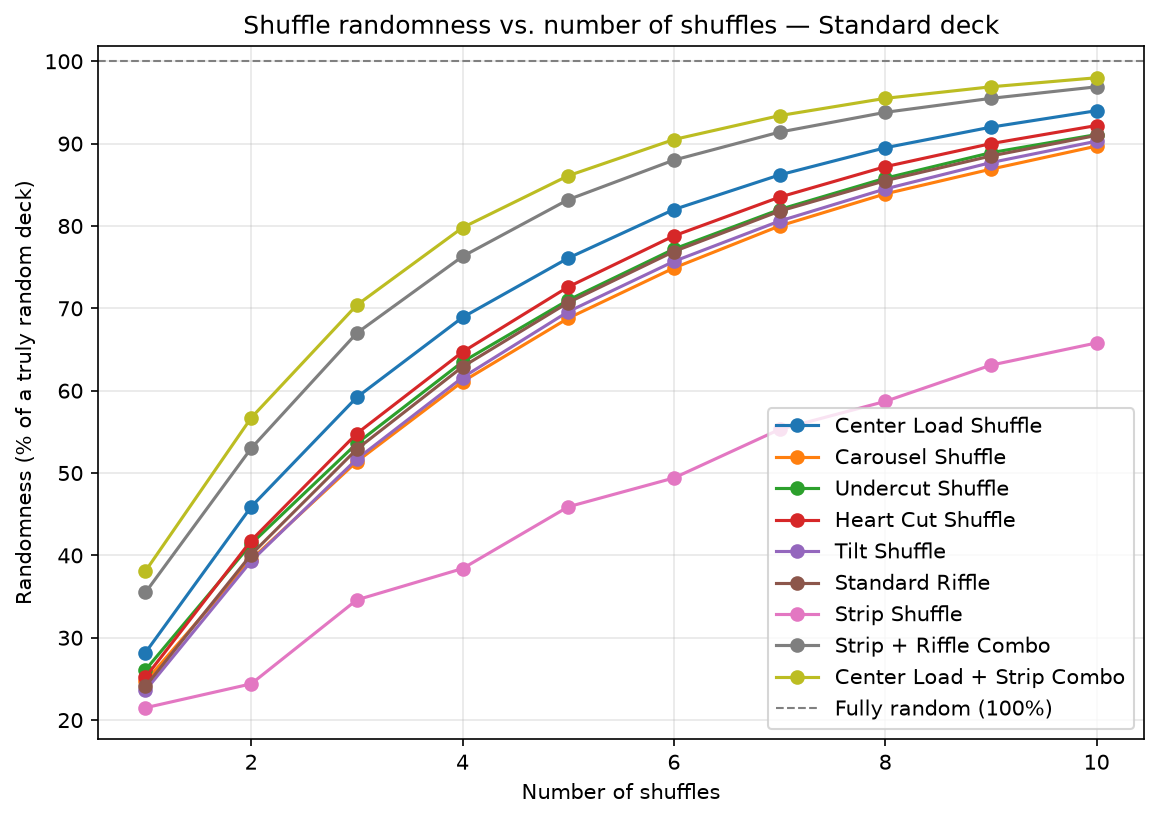
At 7 shuffles:
- Center Load + Strip Combo: 93.4%
- Strip + Riffle Combo: 91.4%
- Center Load Shuffle: 86.2%
- Heart Cut Shuffle: 83.5%
- Standard Riffle: 81.8%
- Undercut Shuffle: 82.0%
- Tilt Shuffle: 80.6%
- Carousel Shuffle: 80.0%
- Strip Shuffle: 55.3%
The Strip Shuffle alone is a clear outlier — it barely reverses packet order and does nothing to break up runs within packets. It needs far more rounds to reach acceptable randomness.
Results — Skibbo deck (60 cards, duplicate values)
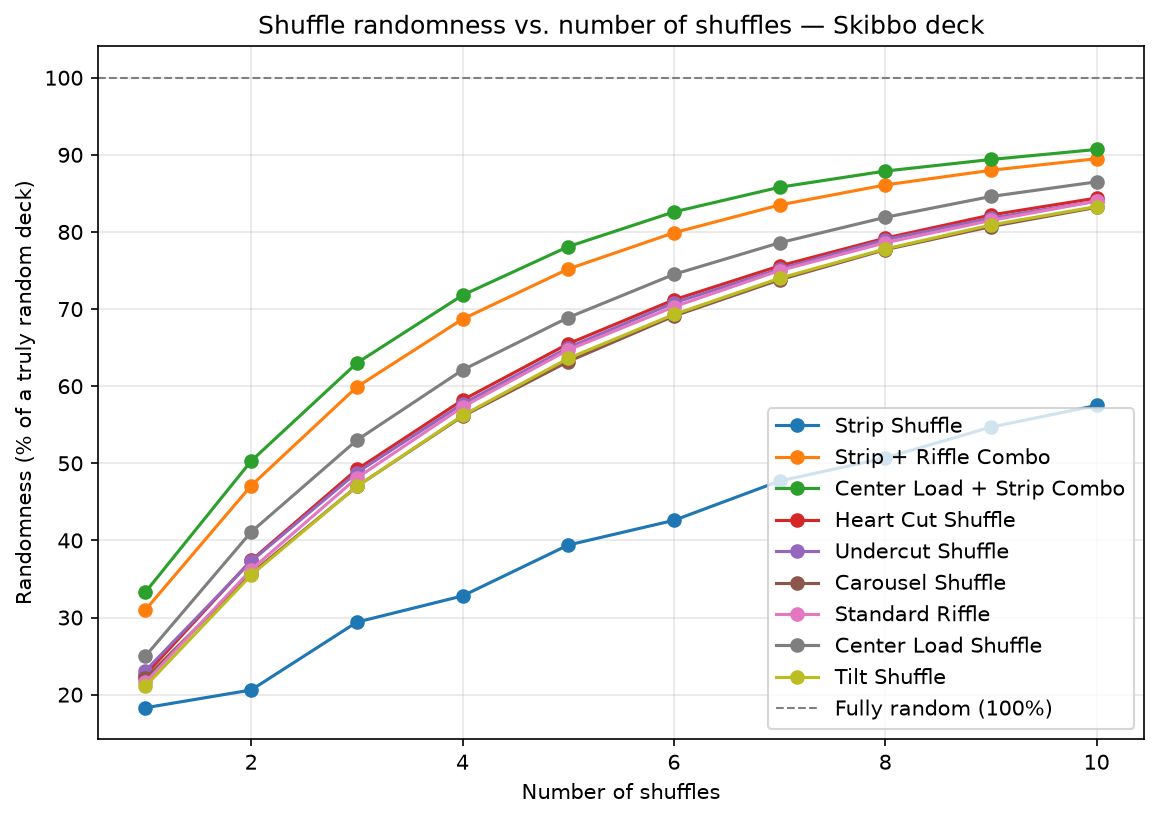
At 7 shuffles:
- Center Load + Strip Combo: 85.8%
- Strip + Riffle Combo: 83.5%
- Center Load Shuffle: 78.6%
- Heart Cut Shuffle: 75.6%
- Undercut Shuffle: 75.2%
- Standard Riffle: 75.0%
- Carousel Shuffle: 73.8%
- Tilt Shuffle: 74.0%
- Strip Shuffle: 47.7%
Duplicate values make the Skibbo deck structurally harder to fully randomize — many card arrangements that look different are functionally identical, which compresses the ceiling on the metric. All methods score a few percentage points lower than on the standard deck. The relative ranking stays the same.
Why Center Load works
The center load restack moves the middle third to the top before the riffle, so when the deck is split for interleaving, cards from the original middle end up alongside cards from the original top and bottom in the same pass. A plain riffle only mixes top-half cards with bottom-half cards; the center region gets broken up more aggressively here.
def center_load_restack(deck):
    n = len(deck)
    fraction = MIDDLE_FRACTION + random.uniform(-FRACTION_WOBBLE, FRACTION_WOBBLE)
    fraction = max(0.05, min(0.95, fraction))

    middle_size = round(n * fraction)
    remaining = n - middle_size
    top_size = remaining // 2 + random.randint(-2, 2)
    top_size = max(0, min(remaining, top_size))

    top = deck[:top_size]
    middle = deck[top_size:top_size + middle_size]
    bottom = deck[top_size + middle_size:]

    return middle + top + bottom
Trade-offs
The combo methods (Center Load + Strip, Strip + Riffle) are more effective because they apply two different disruption mechanisms per round — the riffle breaks up long runs, the strip reverses packet order. The cost is that each "round" is actually two physical operations. If you count individual hand movements rather than rounds, Center Load Shuffle is more efficient per move than any combo method.
The Carousel Shuffle is interesting mechanically — it keeps a rotating aside pile — but in practice it performs no better than a standard riffle at equivalent round counts, with more complexity.
Strip Shuffle alone is not worth using on a fresh ordered deck. It needs roughly twice as many rounds as the next-worst method to reach the same level of randomness.
Files
- CarouselShuffle.py — A Monte Carlo simulation that tests how effectively the "carousel shuffle" randomizes playing cards or token decks by measuring the decay of rising sequences across multiple rounds. The program outputs detailed metrics comparing observed shuffling effectiveness to theoretical randomness benchmarks.
- CenterLoadShuffle.py — This script simulates a "center load shuffle" card-shuffling technique to measure how many shuffles are needed to randomize a deck by tracking the decay of rising sequences (ascending subsequences). It runs thousands of trials across multiple shuffle counts and outputs results to JSON for analysis.
- CenterLoadStripComboShuffle.py — This file simulates the center load followed by strip shuffle combination to measure how quickly it randomizes card decks. It runs thousands of trials across different numbers of shuffles and compares the resulting disorder (measured by ascending sequence count) against the expected random distribution.
- CompareShuffleResults.py — This script analyzes and compares results from different shuffle algorithms by loading JSON result files, calculating randomness percentages relative to a theoretical random baseline, and generating both a text report and visualization charts for each deck type.
- HeartCutShuffle.py — This script simulates a "heart cut shuffle" variant where the middle portion of a deck is extracted and then riffle-shuffled with the combined top and bottom portions, measuring how many shuffles are needed to randomize the deck by counting rising card sequences. It runs experiments on different deck types (Standard 52-card and custom Skibbo 60-card) and outputs results to JSON files.
- Standard-Shuffle.py — This script simulates riffle shuffles to measure how many shuffles are needed to randomize a card deck by tracking the decay of ascending card sequences. It tests multiple shuffle counts and deck types, outputting statistical results to JSON files for analysis.
- stripRiffleShuffle.py — This script simulates a card shuffling algorithm combining riffle and strip shuffles, running thousands of trials to measure how many shuffles are needed to randomize a deck. It outputs statistical results showing how rising sequences decay toward the expected random baseline for different deck configurations.
- StripShuffle.py — This file simulates the strip shuffle—a card-shuffling technique where packets are peeled off the top and dropped onto a growing pile in the other hand—to measure how many shuffles are needed to randomize a deck. It runs thousands of trials for different shuffle counts and tracks the average number of rising sequences (ascending card runs) as a metric of randomness, comparing results against a theoretical random baseline.
- TiltShuffle.py — This script simulates a "tilt shuffle" technique that splits a deck unevenly (roughly 2/3 to 1/3) and interleaves the piles with random hand alternations, then measures how many shuffles it takes to randomize the deck by tracking rising sequences. It runs Monte Carlo trials on standard poker and Skibbo decks to empirically compare the shuffle quality against theoretical randomness.
- UndercutShuffle.py — This file simulates the undercut shuffle (a riffle shuffle preceded by cutting roughly the bottom third of the deck to the top) and measures how many shuffles are needed to achieve randomization on standard playing cards and Skibbo decks. It runs thousands of trials per shuffle count and tracks the decay of ascending card sequences as a metric for randomness.